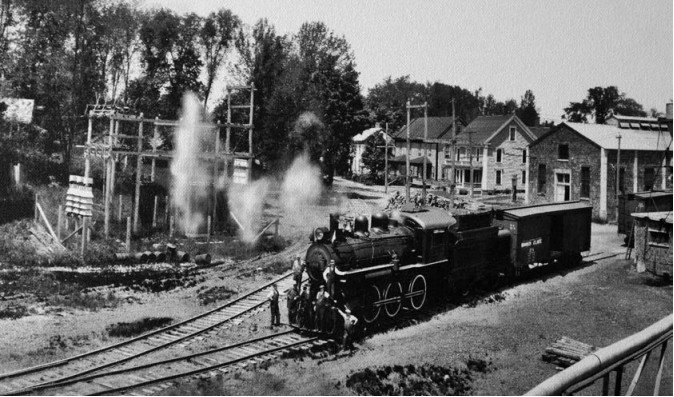
Delivery of bunker C by locomotive (1920s).
George Bishop (FCA, DCL) grew up in Hantsport in a large house, which was built in the mid 1800s by Ezra Churchill’s shipyard carpenters. George and his immediate family shared the large house with his grandparents Roy and Isabel Jodrey, and his great aunt Eva Jodrey. The house was located on the former grounds of the Churchill shipyard which, in the late 1920s became the site of the Minas Basin Pulp and Power mill complex. George grew up playing around the mill site and came to know most of the employees of the mill. Later in life George became Chairman and Director of Scotia Investments and Minas Basin Pulp and Power ltd. and has served as chairman of the Board of Governors of Acadia University as well as many other organizations and foundations. George’s memories of the Minas Basin plant go back to his childhood, and he describes the background of this family business from a uniquely intimate perspective. George and his wife Lorraine live in the Gaspereau valley where George’s grandfather began his career. George and his wife have two daughters.
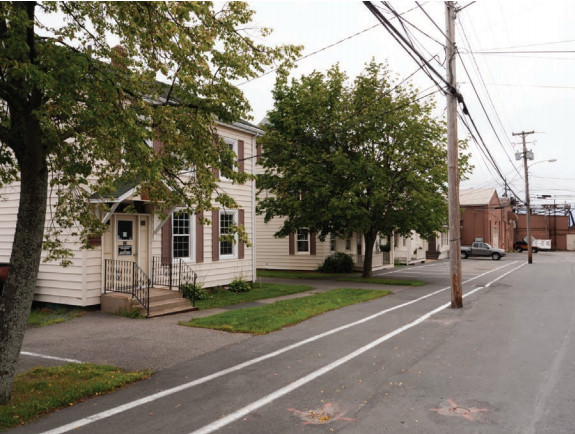
Minas Basin offices. Buildings dating from Churchill shipyard days.
Dick Groot started working from his photographic LightThrough Studio in Wolfville, Nova Scotia, in 2002. He has exhibited Come from Away: Artists of Minas Basin at ViewPoint Gallery in Halifax (2004) and ArtCan Gallery in Canning (2005) and in 2012 he self-published a book by that title. His next solo exhibit was Streets of Cuba at Anderson in Lunenburg (2007). His most recent show was a multi-media installation Tidelines at the Art Gallery of Acadia university (2010). In 2011 he became a “Photosensitive” photographer with his contribution to TIEDtogether an exhibit to raise awareness of prostate cancer. This show has traveled across Canada and in the United States (www.photosensitive.com). Together with Cuban photographer Ricardo Elias, Groot also exhibited Prosperidades Pasadas, a show about abandoned factories, at the Fototeca de Cuba in Havana. The photography of these past enterprises mostly deals with facilities that have closed many years ago, are sometimes in ruins and sometimes re-purposed and in such cases the human toll of closures is far off. However, with the Minas Basin project the human aspect of the closing, from senior managers to workfloor staff, was very present and emotional. You can find out more about Groot’s work by visiting www.eyeopener2013.com or www.ribbontothefuture.ca